Low Down Payment Bail Bonds in Guilford County
Why Guilford County families look for low down payment bail bonds
When a loved one sits in the Guilford County Detention Center, cost becomes the first wall families hit. A magistrate sets a secured bond that requires cash or a surety bond before release. The premium on a surety bond in North Carolina is capped by law at 15 percent of the bond amount under N.C. Gen. Stat. §58-71-95, which means the fee is predictable but still heavy if the bond is large. Families across Downtown Greensboro, College Hill, Lindley Park, Adams Farm, and High Point often do not have the full premium ready at midnight. That is where low down payment bail bonds and real bail bond payment plans in Greensboro matter.
Greensboro is the county seat. The Guilford County Detention Center at 201 S Edgeworth St, Greensboro, NC 27401, phone (336) 641-2700, is the main intake facility. The magistrate’s office is inside that complex and runs all night. Speed depends on how fast a bondsman gets to the magistrate with complete paperwork after a down payment is approved. Proximity matters because each minute saved at intake shaves time off the release clock.
Affordable bonds in Guilford County do not come from cutting corners on the state-regulated premium. They come from payment terms that keep the premium legal but spread it over time at 0 percent interest. That is the difference between families paying only what the law allows and families falling into high-interest debt set off by panic borrowing.
Financing intent is the point: bail bond payment plans Greensboro
The service signal here is financing. Families ask for “bail bond payment plans Greensboro,” “low down payment bail,” or “0 percent interest bail financing.” They want to know how little they must pay today to start the bond and how the rest will be handled after release. They also want to know who qualifies, what documents are needed, and whether collateral is required on higher bonds or riskier charges. Everything below focuses on those questions with Guilford County practice in mind.
What low down payment actually means in Guilford County practice
In North Carolina, the premium is capped at 15 percent under N.C. Gen. Stat. §58-71-95. That fee is nonrefundable by law. Low down payment refers to how much of that premium must be paid today and how the balance is financed. A common qualified option in Greensboro is a 5 percent down structure on bonds of $5,000 and up, or a half-down-half-later plan on many other bonds. For example, on a $7,500 bond, the state-regulated premium is $1,125. With a 5 percent down plan, the down payment would be about $375 with the remaining $750 financed. On a $10,000 bond, the premium is $1,500. A 5 percent down plan would be $500 down and $1,000 financed. These are interest-free balances when structured under a 0 percent interest program, which means the family does not pay more than the premium required by law.
Why this matters: many families try to cover the full premium by borrowing from payday or title lenders at triple-digit annual percentage rates. That turns a $1,500 premium into a debt cycle that can cost multiples of the original fee. 0 percent interest payment plans avoid that trap while keeping the bond moving fast through the magistrate’s window.
How a Greensboro bail bond payment plan moves from call to release
The Guilford County cycle is consistent. A Greensboro police officer books the defendant at 201 S Edgeworth St. The magistrate reviews the case and sets conditions under N.C. Gen. Stat. §15A-534, which covers conditions of pretrial release. “Secured bond” means money or a surety is required for release. “Unsecured appearance bond” means a signed promise to pay later if the person fails to appear. Written promises to appear, which used to be a simple signature, are no longer allowed as a release option under G.S. 15A-534(a) after December 1, 2025. That change is part of Iryna’s Law, Session bail bond payment plans Greensboro Law 2025-93.
Once the secured bond is set, the family calls a bondsman. A plan is qualified over the phone or in person. If the co-signer qualifies, the bondsman prepares the surety bond. The co-signer signs an indemnity agreement, which is a promise to be responsible for the bond if the defendant skips court. The premium down payment is taken. The bondsman walks the bond into the magistrate’s office inside the detention center. Typical release time in Greensboro runs 2 to 4 hours after posting depending on jail traffic and time of day. Late night volume can be lighter, but shift change and dinner hours can cause delays. Large bonds can process faster than expected because the forms are the same and detention staff see them daily.
Release timing in the Greensboro and High Point facilities
The main detention center at 201 S Edgeworth St handles Greensboro arrests. The High Point Detention Center at 507 East Green Drive, High Point, NC 27260, phone (336) 641-7900, handles High Point area arrests. Both facilities use the Guilford County Magistrate’s Office and flow through the same bond forms. Families should expect a 2 to 4 hour window after bond posting in Greensboro, and similar in High Point. Busy weekends and holidays can stretch the window. Quiet weekday mornings can be faster. The release clock starts only after the bond is accepted by the magistrate and the jail confirms no other holds are present, such as an ICE detainer, a probation violation hold, or a warrant in another county.
What families should have ready before a financing call
Guilford County bond paperwork goes faster when the bondsman receives clear, current details on the first call. The detention center can confirm a bond number and charge. The family member on the phone can speed approval by having the co-signer’s employment and residence documents close at hand. Underwriting for payment plans is light when the co-signer is stable and local. It is stricter when distance, charge type, or payment history increase risk.
- Co-signer age 25 or older, with at least 12 months of continuous employment and an open checking account Valid photo ID and a utility bill showing current address within about 45 miles of the Guilford County courthouse Two recent pay stubs or verifiable income proof Defendant’s full name, date of birth, booking number if known, and the bond amount set by the magistrate Confirmation the defendant has lived locally for about 24 months or strong ties such as steady work or family
Collateral and co-signer judgment calls on Greensboro bonds
Not all Guilford County bonds require collateral. Many cases in Greensboro qualify for unsecured indemnity backed by a strong co-signer when the bond is moderate, the charge is nonviolent, and the defendant has local ties. When collateral is required, the focus is on clear, verifiable value. A car title can work with a temporary lien. A home can work with a deed of trust if the home has sufficient equity and the owner understands the risk. Stocks or marketable securities are acceptable when they can be verified and placed under a control agreement. Jewelry and electronics can be considered but usually for smaller balances because appraisal and storage risk reduce usable value. “Net equity” means fair market value minus what is already owed. If a vehicle is worth $12,000 but has a $9,500 loan, net equity is $2,500.
North Carolina property documents must be recorded properly. A deed of trust is the instrument that secures real estate, which is a recorded document placing a lien against the property. The bondsman will explain recording costs and the release process when the case ends. The goal with collateral is to match risk, not to over-secure a bond. Many Greensboro cases with strong co-signers and steady work history clear underwriting without any collateral pledge.
How Iryna’s Law changes bond strategy in late 2025 and forward
Iryna’s Law, Session Law 2025-93, changed pretrial release across North Carolina effective December 1, 2025. The law created a rebuttable presumption against release for violent offenses. A rebuttable presumption means the court starts with the assumption that release is unsafe unless the defense shows evidence to overcome that assumption. For a first violent offense, the judicial official must impose either a secured bond or house arrest with electronic monitoring. For a second violent offense, house arrest with electronic monitoring is required. Three or more prior convictions can trigger secured bond requirements even on lower charges. Written promises to appear are eliminated from the menu of release options under G.S. 15A-534(a), which means a signature alone without money or monitoring is no longer available.
Practically, in Greensboro courtrooms at 201 S Eugene St, these changes shift many cases into secured bond territory that would previously have seen unsecured terms. That drives more families to seek payment plans. It also increases the need for complete background information on the defendant because the magistrate must review criminal history and make written findings, including a documented lookback. The AOC-CR-200 form and criminal history report are part of that record. Judges must complete a 96-hour review in specific situations. Under G.S. 15A-533 and §15A-534, the listed factors include the nature of the offense, ties to the community, employment, and the risk of nonappearance, explained in plain English as the chance the person will miss court.
The dollar math families in Greensboro ask about
Families want to see numbers. On a $5,000 bond in Guilford County, the premium capped under §58-71-95 is $750. A half-down-half-later plan would take $375 today and finance $375 at 0 percent interest. On a $15,000 bond, the premium is $2,250. A 5 percent down structure would be $750 down with $1,500 financed interest-free under a weekly or bi-weekly plan aligned with the co-signer’s payday. On a $50,000 bond, the premium is $7,500. Payment plan approval will weigh the co-signer’s income, length of employment, and whether a second co-signer or collateral is reasonable. Large bonds in Greensboro often qualify for special low rates for homeowners and for attorney referrals, which can lower the effective upfront outlay.
Interest-free is the point. A 0 percent interest structure means there are no financing fees and no hidden costs added on top of the state-regulated premium. With many Greensboro families living paycheck to paycheck, this structure prevents compounding debt while still moving the bond to the magistrate window quickly.
Greensboro detention specifics that affect payment plan timing
The Guilford County Detention Center holds the defendant until bond is posted, any holds clear, and jail staff finalize release paperwork. The magistrate’s office is on-site at 201 S Edgeworth St and sets bonds 24 hours a day. Families can check inmate status at the county’s online search at inmatesearch.guilfordcountync.gov. The Guilford County Sheriff’s Office is at 300 West Washington Street, Greensboro, NC 27401, phone (336) 641-3694, and can confirm facility information. When a bondsman is within one block of the detention center, the walk from the office to the magistrate window is minutes, which reduces back-and-forth delays that occur when a bondsman must drive from another county.
Release speed depends on two things families can control. First, get co-signer documents ready so underwriting is immediate. Second, call a bondsman who can physically reach the Edgeworth Street magistrate window within minutes once approval is granted. Every minute between approval and presentation to the magistrate pushes release back, especially during high-volume hours when staff batch paperwork. Guilford County staff are efficient, but the clock does not start until the bond is in their hands.
What happens if a payment is missed on a Greensboro bail plan
A payment plan is an agreement to pay the state-regulated premium over time. Missing a payment is a contract breach. In practice, reputable agencies call the co-signer, attempt to cure the default, and document a plan to catch up. If payments cannot be cured and the risk to the bond increases, the agency can file a motion to be released from the bond, which means the court could revoke the bond and issue a new custody order. Families should call before a payment date if a problem is coming. That call often avoids enforcement. After the case ends and the bond is exonerated, collateral is released and any recorded documents are terminated, which means the lien is removed.
Guilford County courts also run a 90-day bond forfeiture timeline when a defendant misses court. Under North Carolina’s forfeiture statutes, the court issues a forfeiture notice. There is a window to set the forfeiture aside based on listed reasons, including surrender of the defendant or proof of court error. Families should know a missed payment and a missed court date are separate problems. The first is financial. The second can trigger legal forfeiture and a bench warrant. Both issues are manageable when the bondsman and co-signer communicate early.
Charge types in Greensboro that influence down payment and collateral
Not all charges carry the same risk. Misdemeanor charges like simple possession or shoplifting with modest bonds often qualify for 5 percent down with no collateral if the co-signer is stable and local. DWI bonds in Greensboro under N.C. Gen. Stat. §20-138.1 vary based on aggravating factors and prior convictions. Domestic violence cases have unique timing rules, including a possible initial hold before a judge sees the case, which can delay how quickly the bond can be posted.
Felony charges like assault with a deadly weapon or drug trafficking under N.C. Gen. Stat. §90-95(h) often carry higher bond amounts. With Iryna’s Law, violent felonies move more cases into secured bond territory and can drive co-signer stacking or collateral requirements. In practice, Greensboro bondsmen weigh local employment stability, residence history around zip codes like 27401, 27403, 27405, 27406, 27407, and 27410, and ties to neighborhoods such as Fisher Park, Glenwood, Irving Park, Hamilton Lakes, and Sedgefield. Strong ties lower risk and can reduce or eliminate collateral on bonds that would otherwise need it.
What “credit-check-free” or “no collateral” can mean in real terms
Families often ask for credit-check-free bail or no collateral bail bonds. In Greensboro, many approvals do not require a hard credit pull. Instead, underwriting relies on document-driven proof of income, residence stability, and co-signer age and employment history. “No collateral” means the agency accepts an unsecured indemnity backed by a qualified co-signer. It does not mean there is no liability. The co-signer remains responsible if the defendant misses court and the bond is forfeited. A second co-signer can sometimes replace the need for collateral on a mid-sized bond when both co-signers meet age, employment, and residence thresholds.
How map-pack level proximity changes Greensboro release time
Greensboro bond processing is geography-sensitive. The magistrate’s office that accepts the surety bond sits inside the detention complex at 201 S Edgeworth St. Agencies one block from the jail can finish documents at their office and physically hand the bond to the magistrate within minutes. That tight loop compresses the paperwork-to-release time compared to bondsmen who must drive across the county or in from another city. Jail volume still sets the final release window, but families see shorter overall timelines because the bond reaches the queue faster.
Legal framework that shapes Guilford County payment plans
Families in Greensboro hear legal terms. The core ones are simple with plain explanations:
N.C. Gen. Stat. §15A-531 defines a bail bond. It is a written promise, with or without money, to make sure a defendant appears in court. N.C. Gen. Stat. §15A-533 sets general rules, including when a person is eligible for release. N.C. Gen. Stat. §15A-534 lists the conditions of release. That section now operates with changes from Iryna’s Law, which removed the written promise to appear option and created new requirements for bonds and electronic monitoring on violent offenses. N.C. Gen. Stat. §58-71-95 caps the bail bond premium at 15 percent or $150, whichever is greater. That cap applies to every licensed North Carolina bondsman. The Eighth Amendment and Article I, Section 27 of the North Carolina Constitution prohibit excessive bail, which in plain English means the court cannot set bail so high that it punishes rather than ensures appearance and safety.
Greensboro judges and magistrates must also make written findings in certain cases and review criminal histories before setting bond. A 96-hour judicial review can apply in specific violent offense contexts. A ten-year lookback on prior convictions under G.S. 15A-523 is part of how risk is evaluated across repeat cases. All of this shapes whether a secured bond is required and, if so, whether a payment plan is the family’s only realistic path to release.
Guilford County neighborhoods and coverage that influence approvals
Families from across Greensboro call for the same reason: someone they love is in a cell and cannot sleep. Coverage stretches from Downtown Greensboro to Fisher Park, College Hill, Lindley Park, Glenwood, Irving Park, Sunset Hills, Westerwood, Adams Farm, Friendly Center, Hamilton Lakes, Sedgefield, and the Wendover and Battleground corridors. High Point families near Oakview, Deep River, and Emerywood reach the High Point facility. Summerfield, Stokesdale, Pleasant Garden, McLeansville, Jamestown, Gibsonville, Oak Ridge, and Colfax sit within the service radius. Zip codes across 27401, 27403, 27405, 27406, 27407, 27408, 27409, 27410, and 27455 show up most during overnight calls. The closer and steadier the co-signer’s footprint inside Guilford County, the stronger the chance of a low down payment approval without collateral.
Large bonds in Greensboro and how financing scales
Six-figure bonds raise the stakes for families and for the agency. Greensboro has seen $250,000 bonds post in under 2 hours when the co-signers were ready, the paperwork was clean, and detention staff were in the lighter part of their shift. Large-bond https://localbusinessus.blob.core.windows.net/apex-bail-bonds/greensboro/bail-bond-payment-plans-in-greensboro-nc.html approvals rely heavily on the co-signer stack, employment stability, and property documentation when collateral is requested. Interest-free payment plans still apply on the premium even at this scale, which keeps the total cost from ballooning beyond what the law allows. Special rates for homeowners or for attorney referrals can reduce the premium within the lawful cap. Same-day underwriting on large bonds is possible when co-signers bring in pay stubs, utility bills, deeds, and bank information without delay.
How Greensboro families compare payment plans to payday loans
The choice at 2 AM feels like “anything to get him out.” That is when predatory loans look tempting. A Greensboro family needing $1,500 to cover a premium might take a payday loan with an annual percentage rate over 300 percent. That turns a short-term fix into a long-term problem with rollovers and penalty fees that never end. A 0 percent interest bail bond payment plan avoids interest entirely on the premium balance. It also aligns with paydays, which gives the co-signer time to manage work, pick up the defendant, and start preparing for court without a growing interest clock. The money saved by avoiding interest often covers attorney consultations or treatment programs that improve case outcomes.
Guilford County detention contacts and first appearance logistics
Families want phone numbers they can trust. The Guilford County Detention Center is at 201 S Edgeworth St, Greensboro, NC 27401, phone (336) 641-2700. The High Point Detention Center is at 507 East Green Drive, High Point, NC 27260, phone (336) 641-7900. The Guilford County Courthouse is at 201 S Eugene St, Greensboro, NC 27401, phone (336) 412-7300. The magistrate’s office is located inside the detention center complex in Greensboro and inside the High Point facility in High Point. These offices process bonds around the clock. First appearances are set by the court and can impact timing, especially on domestic cases. A bondsman who works daily inside these buildings understands when to push for immediate posting and when to wait for the judge’s review window.
What makes a payment plan decision realistic in Greensboro
Approvals are case by case. A co-signer over 25, employed for a year or more, with a local address and an open checking account is the backbone of most low down payment plans. If the defendant has lived locally for two years and has current work or school in Guilford County, risk drops. If the defendant has a history of missing court or faces a violent offense with the new Iryna’s Law presumption, risk rises. A second co-signer or collateral may be requested. Exceptions exist. Strong veteran status, homeowner status, or an attorney referral can be positive factors in underwriting. Payment schedules can be weekly, bi-weekly, or monthly, and the total term depends on the size of the premium balance and the co-signer’s income pattern.
How the online inmate search and bond numbers help the process
Guilford County’s inmate search at inmatesearch.guilfordcountync.gov helps families confirm that the person is booked, the listed charges, and sometimes the bond amount. A bondsman will still verify bond conditions with the jail and the magistrate, but having the booking number ready cuts minutes off the intake call. Minutes matter when every step triggers the next step in the sequence. Booking number, charge list, bond amount, and any holds or detainers form the base for a fast payment plan decision.
Operational habits that shrink Greensboro release times
Three habits change outcomes in Guilford County. First, use a bondsman who works inside the 201 S Edgeworth St complex daily and can present bonds within minutes of approval. Second, finish co-signer paperwork in one sitting. Back-and-forth gaps at 1 AM often mean staff shifts, and shifts can push a release from 2 hours to closer to 4 hours. Third, confirm that there are no other holds that would slow release after the bond posts. An out-of-county warrant, a probation hold, or an ICE detainer will keep the defendant in custody even if the Greensboro bond clears instantly. Knowing this early saves families from sitting in the parking deck wondering why release has not happened.
Neighborhood-driven examples of payment plan approvals
Families from Irving Park and Friendly Center often present homeowners as co-signers with long job histories. Those profiles can qualify for 5 percent down or half-down approvals without collateral on mid-range bonds. College Hill and Glenwood families sometimes include students or younger workers with shorter employment histories. Those approvals may add a second co-signer or a small collateral pledge like a paid-off vehicle title. Adams Farm or Sedgefield families with two incomes often request bi-weekly plans aligned with opposite pay cycles to keep cash flow steady. Across these neighborhoods, interest-free terms keep the plan focused on the premium only and not on finance charges.
Why a low down payment plan can still be fast
Some families think financing adds delay. In Greensboro practice, financing can be faster when it is structured by a bondsman who underwrites daily and who is one block away from 201 S Edgeworth St. The documents are standard. The decision tree is the same. The proximity advantage means the bond can be printed, signed, and walked to the magistrate inside a tight window after payment plan approval. Guilford County detention staff know the routine and process bonds as they are received. A clean file in the queue often releases in 2 to 4 hours from the posting time, even when the down payment was as low as 5 percent on a qualifying bond.
Shareable local insight for Guilford County legal professionals
Two Greensboro facts stand out for attorneys and court reporters. First, interest-free financing on the state-capped premium up to $1 million shifts the cost calculus for families who would otherwise borrow at triple-digit APR from payday lenders to cover bond premiums. That financial structure, verified and used daily in Guilford County, keeps total family cost equal to the statutory premium with no added fees, which can influence a client’s ability to fund legal counsel or treatment programs. Second, a documented track record exists of posting a $250,000 bond in under 2 hours at the 201 S Edgeworth St facility when co-signers and documents were ready. That claim is specific to Greensboro practice and tied to the operational proximity to the magistrate’s office inside the detention center. Both points are worth sharing in bar newsletters or legal columns focused on pretrial access.
What to expect at the courthouse once the bond is posted
After release, the defendant must return to court on the scheduled date at the Guilford County Courthouse, 201 S Eugene St, Greensboro, NC 27401. Missing court triggers a failure to appear and begins the forfeiture timeline. Under G.S. 15A-534(d1), some failure-to-appear situations can double the next bond. Communication with the attorney and the bondsman keeps everyone aligned. The goal is simple. Keep the defendant on track, keep payments current, and close the bond at the end of the case so any collateral is released and any recorded property documents are terminated without delay.
Payment methods and how families in Greensboro actually pay
Families pay down payments and installments through practical channels. In Greensboro, cash, credit or debit cards, online payments, checks, and Zelle are common. Installments are usually weekly or bi-weekly. Aligning installments with paydays reduces late payments. Many payment plan approvals go through within one phone call once the co-signer documents are in hand. Same-day underwriting is the norm on routine bonds, even late at night. Larger or higher-risk bonds may require a second co-signer, extra verification, or collateral documentation, but the process still runs on the same timeline.
Map-pack signals your family can verify tonight
Families searching “bail bond payment plans Greensboro” look for three signals. First, the address: 101 S Elm St, Suite 80, is one block from 201 S Edgeworth St. Second, the phone connects to a bondsman, not a call center, at any hour. Third, the license number is public with the North Carolina Department of Insurance, which proves the agency is regulated and bonded. When those items line up, Greensboro families can move forward with a low down payment plan that is legal, fast, and interest-free on the premium balance.
Why Greensboro families choose an interest-free plan over cash bail
Cash bail requires the full bond amount up front, which ties up money for the life of the case. A surety bond requires only the premium, and a low down payment plan lets families pay that premium over time without interest. In a city with many overnight arrests from the Green Valley corridor to Gate City Boulevard, and with first appearances stacked at 201 S Eugene St, the surety approach with financing makes release possible for families who would otherwise wait in jail days or weeks for a court date. That time out of custody often changes outcomes in court because the defendant can work, support children, and meet with counsel.
Why Greensboro families call Apex Bail Bonds for low down payment plans
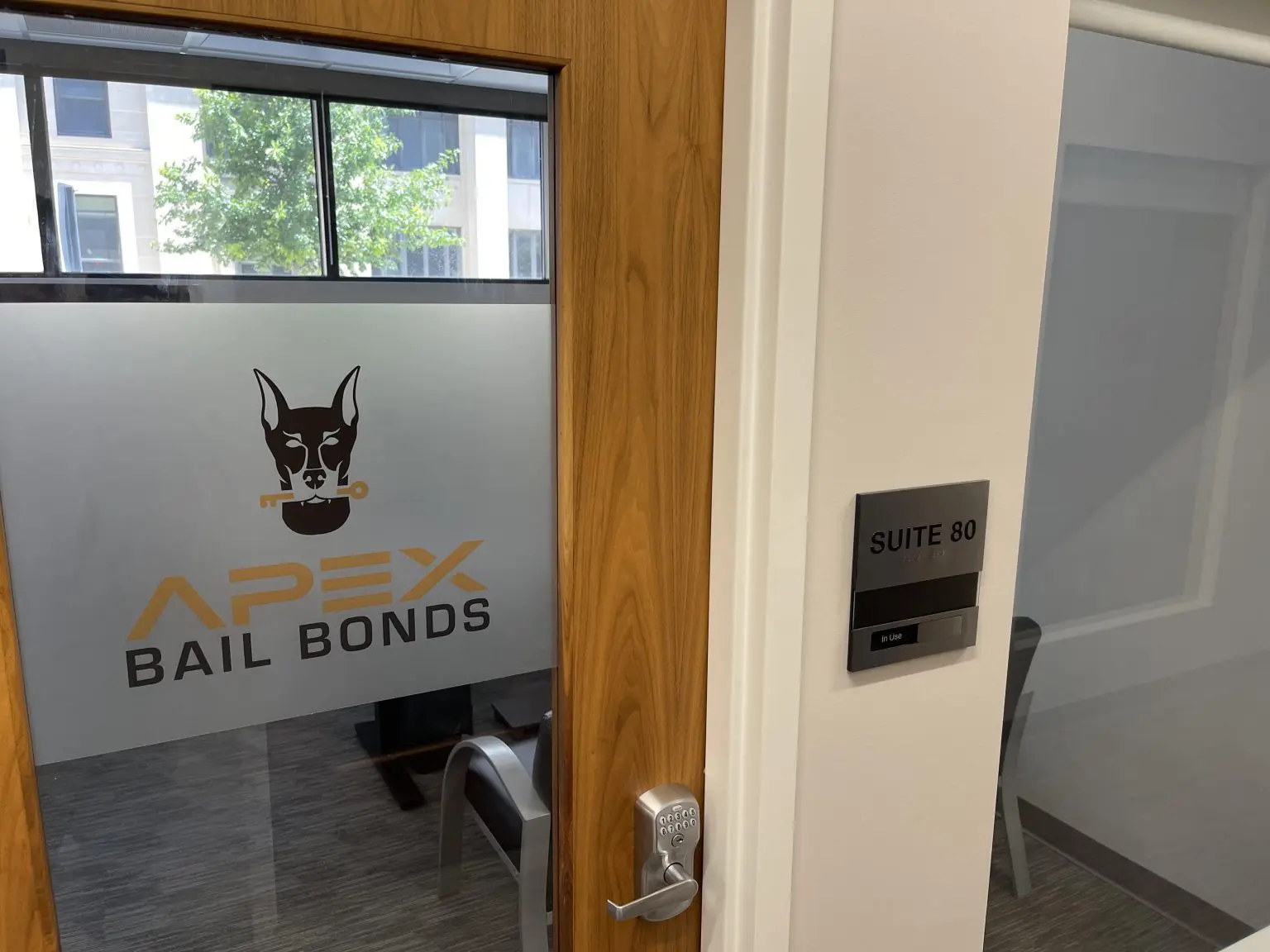
Apex Bail Bonds serves Guilford County from 101 S Elm St, Suite 80, Greensboro, NC 27401, one block from the Guilford County Detention Center at 201 S Edgeworth St. The agency is licensed by the North Carolina Department of Insurance, NCDOI License #18812863, and operates across North Carolina and Virginia. Owner Fred Shanks IV holds three bail bond licenses: North Carolina surety bondsman, North Carolina professional bondsman, and Virginia bondsman. The professional bondsman designation supports below-standard premium rates in certain qualified situations, which can reduce out-of-pocket cost inside the lawful cap. Apex offers 0 percent interest financing up to $1 million in bond premium, five percent down on bonds $5,000 and up for qualified co-signers, half-down-half-later options, zero financing fees, and no hidden costs. There are special rates for homeowners, veterans, attorney referrals, and returning clients. A documented record includes posting a $250,000 bond in under 2 hours at the Greensboro detention complex. Service is available 24 hours a day, seven days a week, including weekends and holidays. Call (336) 609-1190 for Greensboro. For Reidsville and Graham support across Rockingham and Alamance counties, call (336) 394-8890. Families who need immediate, affordable bail bond payment plans in Greensboro can get same-day underwriting and interest-free installments that keep the premium at the legal cap without predatory finance charges.